
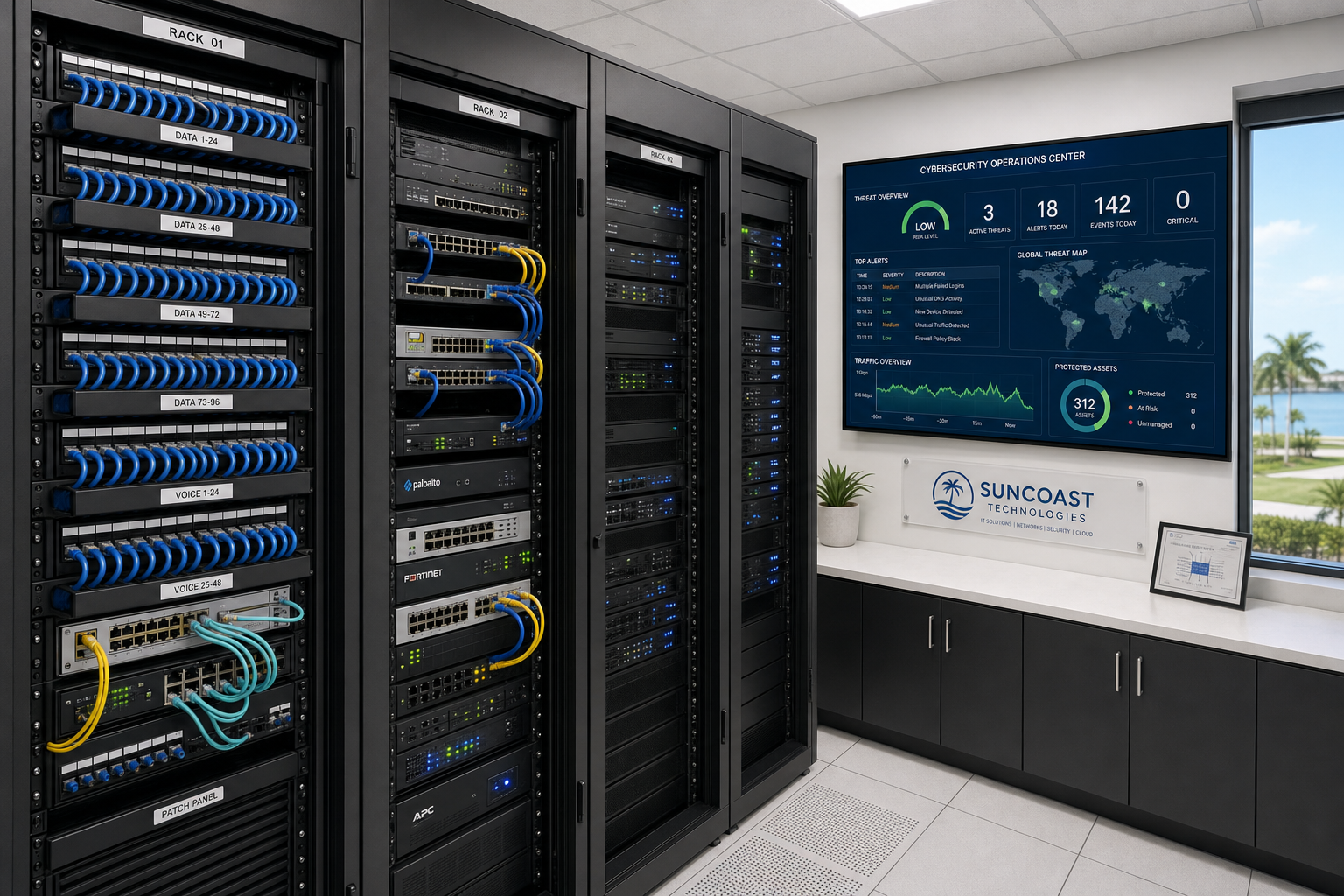
When Managed IT Makes Sense After 30 Employees
When Managed IT Makes Sense After 30 Employees
At some point between your 25th and 40th hire, something shifts. The shared Google Drive starts breaking down. Your phones drop calls at the worst moments. Someone’s laptop gets a virus and nobody knows who to call. IT problems that used to be minor annoyances start costing you real time and real money. If your Central Florida business is approaching or past 30 employees, this guide will help you decide whether managed IT is the right move — and what to expect if you make it.
Why 30 Employees Is the Inflection Point
Below 15 employees, most businesses can get by with a part-time IT person, a tech-savvy office manager, or a break-fix vendor they call when something breaks. It’s not ideal, but it works well enough.
Between 15 and 30 employees, cracks start to show. You’re adding workstations, phones, and cloud accounts faster than anyone is documenting them. Your network closet looks like a bowl of spaghetti. Microsoft 365 licenses are assigned inconsistently. Nobody has a real offboarding process when an employee leaves.
At 30 employees and beyond, those cracks become real business risks. You now have enough staff that a single network outage affects dozens of people simultaneously. You have enough data that a ransomware attack or a phishing breach is genuinely damaging. You have enough phone traffic that dropped calls and poor audio quality cost you client relationships. And you have enough complexity that no single part-time person can keep up with it all.
This is the point where managed IT stops being a luxury and starts being a practical business decision.
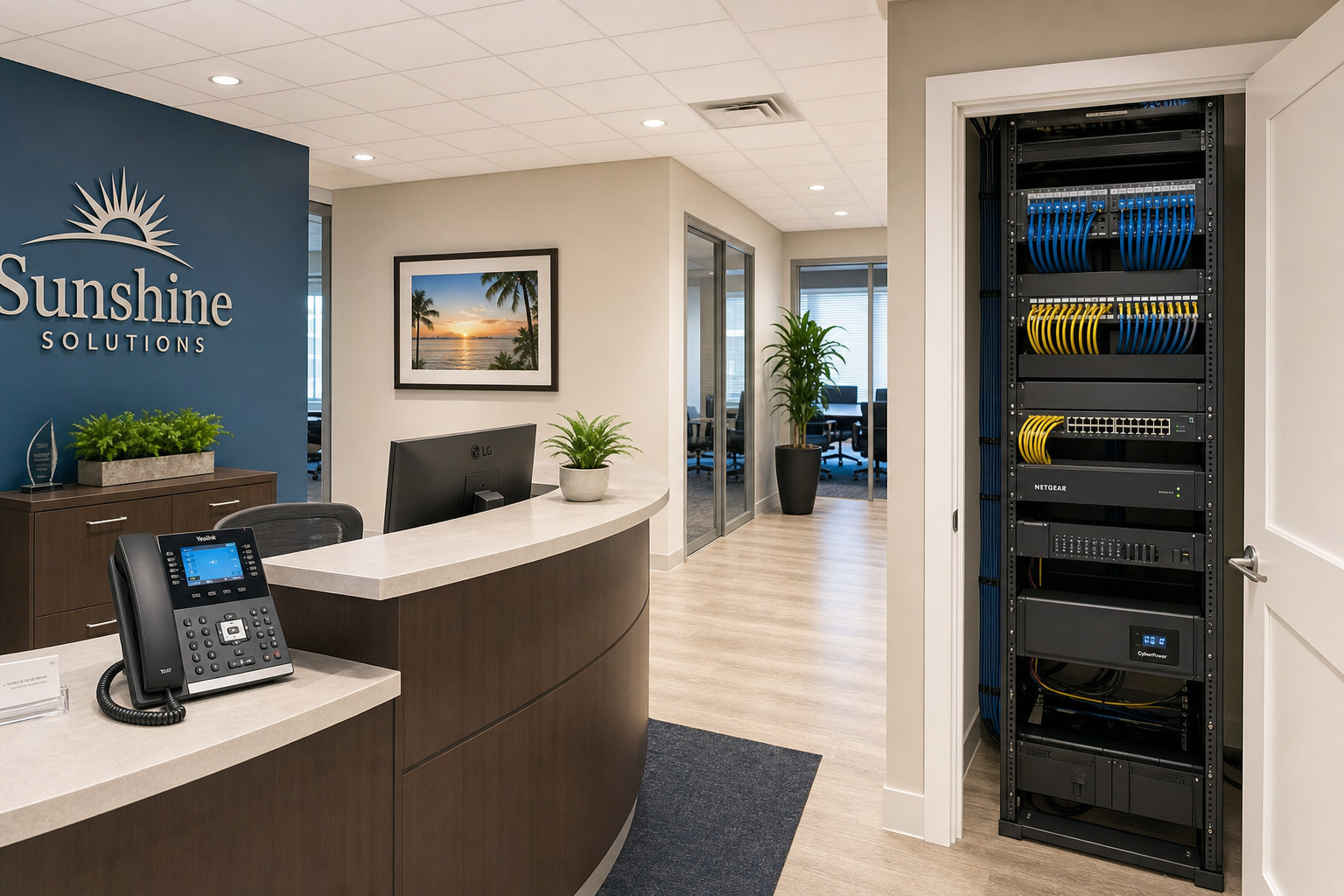
Managed IT vs. Your Other Options
Before deciding, it helps to see your real options side by side. Here’s an honest comparison for a Florida business at the 30-plus employee stage:
| Option | Cost Structure | Response Time | Proactive Monitoring | On-Site Support | Vendor Coordination | Best For |
|---|---|---|---|---|---|---|
| Mynians Managed IT (local) | Published MSP base; helpdesk labor billed separately | Availability and timing per written scope | Yes — 24/7 monitoring included | Yes — real techs on-site | One team handles IT, VoIP, cabling, security | 30–200 employee Florida businesses |
| National MSP | Monthly contract, variable add-ons | Slower — remote-first, on-site extra | Yes | Limited or subcontracted | Often separate vendors for phone and cabling | Businesses with no local preference |
| In-House IT Staff | Salary + benefits + tools + training | Fast when available | Depends on individual skill | Yes | Employee manages all vendors | 100+ employee companies with IT budget |
| Break-Fix Vendor | Per-incident billing, unpredictable | Slow — reactive only | None | Yes, when called | None — you coordinate everything | Under 15 employees, low IT dependency |
| DIY / Office Manager | Hidden cost in lost productivity | Varies widely | None | Yes | None | Very small teams, simple setups |
Who This Is For
Managed IT at this stage is a strong fit if your business matches most of these:
- You have 30 or more employees and that number is growing.
- You rely on computers, phones, and internet connectivity to serve clients or run operations daily.
- You’ve had at least one significant IT problem in the past 12 months — an outage, a security scare, a phone system failure, or a botched hardware setup.
- You’re spending more than a few hours per week dealing with IT issues yourself or delegating them to someone who isn’t an IT professional.
- You’re planning an office move, expansion, or new location in Florida and need structured cabling and network infrastructure done right the first time.
- You want predictable IT costs instead of surprise invoices every time something breaks.
Who This Is NOT For
Managed IT is not the right fit for every business. Be honest with yourself here:
- You have fewer than 15 employees and your IT needs are genuinely simple — a few laptops, basic internet, and a cloud email account.
- You already have a dedicated, qualified in-house IT team and your infrastructure is well-documented and well-maintained.
- Your business operates almost entirely on paper or phone with minimal technology dependency.
- You’re not willing to follow basic security policies — managed IT requires some cooperation from your team to be effective.
Warning Signs You’ve Outgrown Break-Fix
If you’re still on the fence, these are the clearest signals that your current IT approach isn’t scaling with your business:
- Recurring outages: The same network or server issue keeps coming back because nobody is monitoring it proactively.
- Slow onboarding: Setting up a new employee takes days instead of hours because there’s no standard process.
- Vendor finger-pointing: Your internet provider blames your phone system, your phone vendor blames your router, and nobody takes ownership.
- Security gaps: You’re not sure whether your team’s devices have endpoint protection, or whether your Microsoft 365 accounts have multi-factor authentication enabled. The Cybersecurity and Infrastructure Security Agency (CISA) consistently identifies MFA gaps as one of the top attack vectors for small and mid-size businesses.
- No documentation: If your most tech-savvy employee left tomorrow, nobody would know your network passwords, your ISP account numbers, or your software license keys.
- Poor phone quality: Dropped calls, echo, or choppy audio on client calls — especially if you’re still on an aging on-premise phone system.
What Managed IT Actually Covers
Managed IT is not just a help desk you call when your computer crashes. At Mynians, managed IT for a 30-plus employee Florida business typically includes:
- 24/7 network and endpoint monitoring — problems are caught before they become outages.
- Patch management and updates — operating systems, software, and firmware are kept current across all devices.
- Cybersecurity layers — endpoint protection, email filtering, and policy enforcement aligned with NIST Cybersecurity Framework best practices.
- Microsoft 365 and cloud management — user accounts, licenses, permissions, and backups handled correctly.
- Help desk support — real answers from real techs, not a scripted overseas call center.
- Vendor coordination — Mynians deals with your ISP, software vendors, and hardware suppliers so you don’t have to.
- IT documentation — your network is mapped, labeled, and documented so any technician can support it efficiently.
- Strategic IT planning — budgeting for hardware refresh cycles, capacity planning, and technology decisions that match your growth.
VoIP and Cabling: Why They Matter at This Stage
Most managed IT conversations focus on computers and servers. But at 30-plus employees, your phone system and physical network infrastructure are just as critical — and just as likely to be causing problems.
Hosted VoIP at Scale
If you’re still running an aging on-premise phone system, you’re paying for hardware maintenance, missing features your competitors have, and dealing with call quality issues that a properly configured hosted VoIP system would eliminate. A cloud-based VoIP system gives your team desk phones, mobile apps, voicemail-to-email, call routing, and conference calling — all managed from a single dashboard. When your phone system and your IT infrastructure are managed by the same team, call quality problems get resolved faster because there’s no vendor finger-pointing.
The FCC’s VoIP guidance is a useful reference for understanding how hosted phone systems differ from traditional landlines in terms of reliability and regulatory considerations.
Structured Cabling Done Right
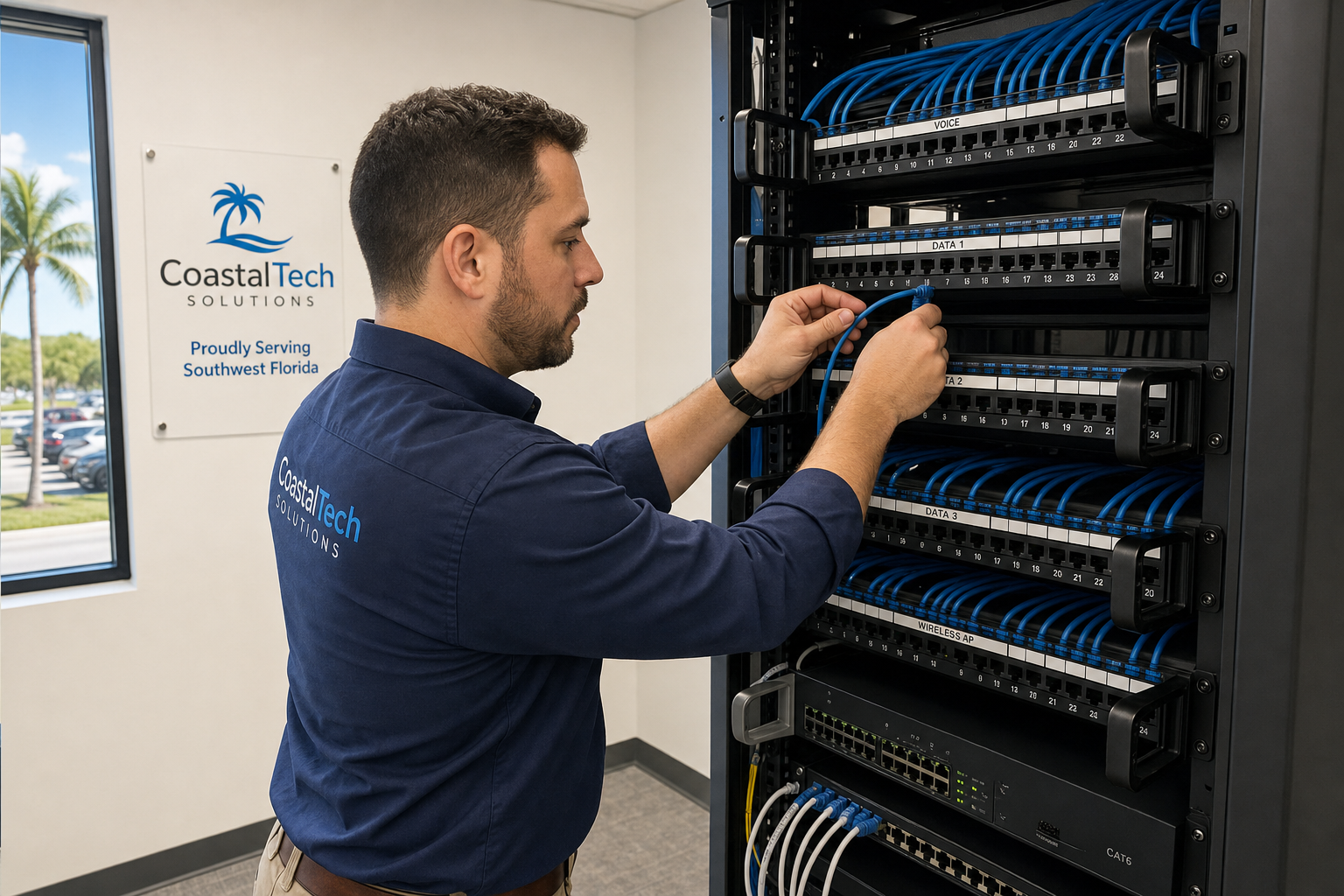
A 30-employee office has a lot of cable runs — workstations, IP phones, access points, security cameras, printers, and servers. If those runs were installed piecemeal over the years, you likely have unlabeled cables, mixed cable categories, and patch panels that nobody has touched since the last office manager left. BICSI standards exist precisely because structured cabling done correctly is the foundation of a reliable network. Mynians handles cabling as part of the same engagement — clean installs, proper labeling, and documentation that actually matches what’s in the wall.
Cost, Setup Time, and What Can Go Wrong
What Does Managed IT Cost?
Managed IT pricing varies by provider and scope, but the model is typically a flat monthly rate per user or per device. For a 30-to-50 employee business in Central Florida, this is almost always less expensive than the combined cost of reactive break-fix bills, lost productivity from downtime, and the salary of a full-time IT employee. Mynians uses flat-rate pricing — published base rates and separate support charges, automated maintenance is included, while all user-requested helpdesk support is billed separately under Schedule B.
How Long Does Onboarding Take?
A realistic onboarding timeline for a 30-employee business is two to four weeks. The first phase is discovery and documentation — auditing your existing hardware, software, network, and cabling. The second phase is remediation — fixing the things that need fixing before ongoing management begins. The third phase is steady-state management. Businesses that have clean infrastructure onboard faster. Businesses with years of deferred maintenance take longer, but the remediation work is what makes ongoing support reliable.
What Can Go Wrong?
The most common problems during a managed IT transition are:
- Discovering undocumented systems or software that nobody knew existed.
- Finding that existing cabling doesn’t support the speeds your business needs.
- Uncovering security gaps — unpatched systems, shared passwords, or accounts belonging to former employees that were never deactivated.
- Resistance from staff who are used to doing things their own way.
None of these are reasons to avoid managed IT. They’re reasons to start sooner rather than later.
Why Local Support Matters in Florida
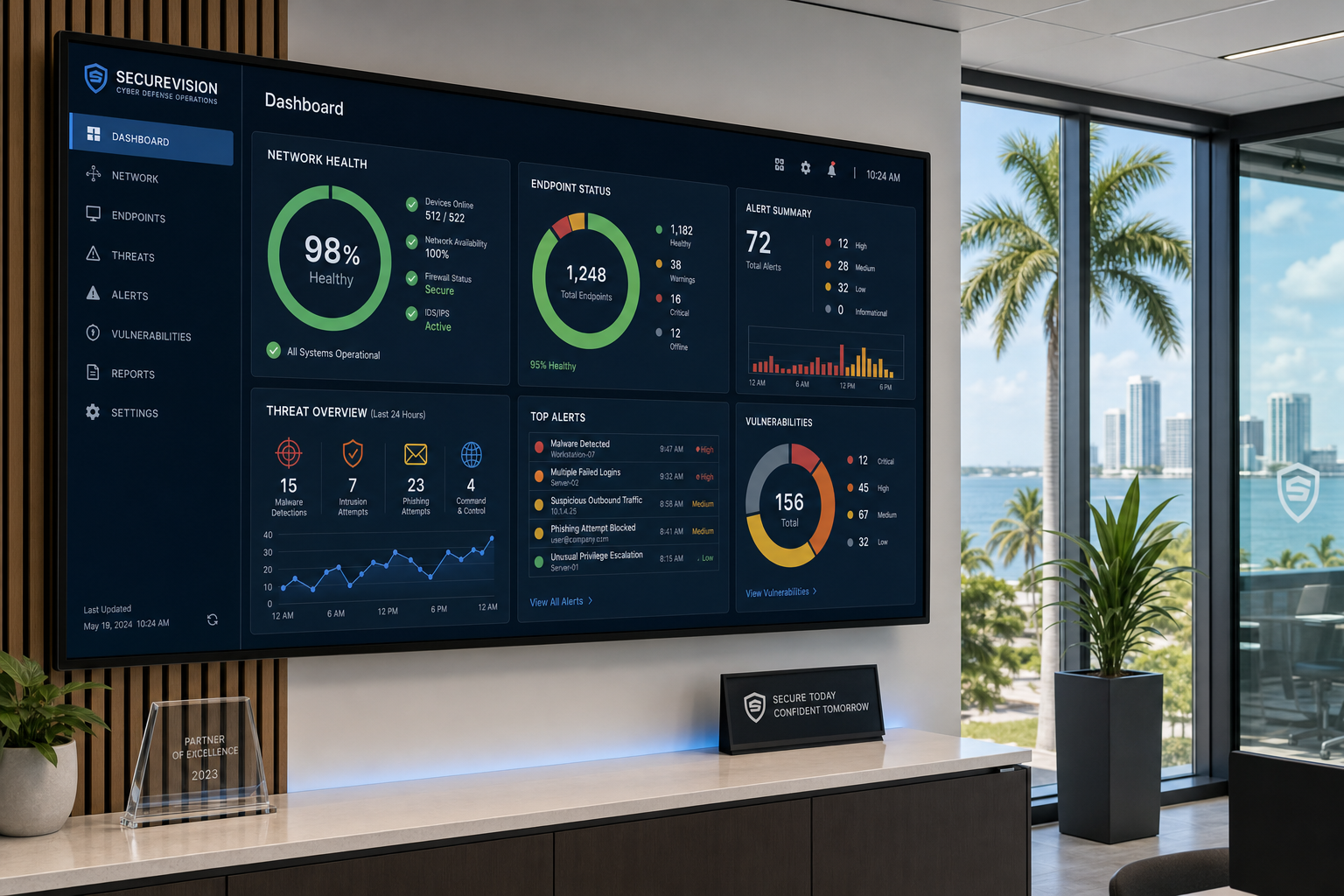
National managed IT providers can monitor your network remotely. What they can’t do is show up at your Winter Garden or Orlando office the same afternoon when a switch fails, a cabling run needs to be traced, or a new workstation needs to be physically set up. Remote support handles a lot — but not everything.
Mynians serves businesses across Central Florida, including Orlando, Winter Garden, Tampa, Miami, and Jacksonville. Our technicians are local. When you call, you reach someone who knows your environment, has been to your office, and can be there in person when the situation calls for it. That’s a meaningful difference when your business is down and every hour costs you money.
There’s also the accountability factor. A local provider’s reputation depends on the businesses in its own community. That’s a different kind of incentive than a national provider managing thousands of accounts from a central operations center.
How to Get Started With Mynians
The lowest-risk first step is a free IT assessment. Here’s what that looks like in practice:
- Initial conversation: You tell us about your business, your current setup, and the problems you’re experiencing. No technical jargon required.
- On-site or remote assessment: We look at your network, your devices, your cabling, your phone system, and your security posture. We document what we find.
- Written findings: You get a clear picture of where your gaps are — whether you move forward with Mynians or not.
- Proposal: If it makes sense to work together, we put together a flat-rate proposal with no hidden fees and a clear scope of work.
You can reach us at mynians.com/contact-us or call (407) 374-2782.
Frequently Asked Questions
How do I know if my business is ready for managed IT?
The clearest indicators are recurring IT problems, unpredictable support costs, security gaps you’re not sure how to close, and IT tasks eating into your or your team’s productive time. If you have 30 or more employees and any of those apply, a managed IT assessment is worth the conversation.
Is managed IT more expensive than break-fix support?
On a monthly basis, managed IT costs more than a month with no IT problems. But break-fix billing is unpredictable — a single server failure or ransomware incident can cost far more than months of managed IT fees. Flat-rate managed IT gives you predictable costs and proactive prevention, which typically reduces total IT spending over time.
Can Mynians handle our phone system and cabling too?
Yes. Mynians handles managed IT, hosted VoIP phone systems, and structured cabling under one roof. This matters because most IT problems at the 30-plus employee stage involve all three — and having separate vendors for each creates finger-pointing and slower resolution times.
What areas of Florida does Mynians serve?
Mynians is based in Winter Garden, Florida and serves businesses across Central Florida including Orlando, Winter Garden, Tampa, Miami, and Jacksonville. Our technicians are local — not an overseas call center.
How long does it take to get set up with a managed IT provider?
For a 30-to-50 employee business, expect a two-to-four week onboarding process. This includes an audit of your existing environment, documentation, remediation of any critical issues, and transition to ongoing managed support. Businesses with cleaner infrastructure onboard faster.
What happens to our data and systems during the transition?
A responsible managed IT provider will audit and document your environment before making any changes. At Mynians, we don’t make changes that haven’t been reviewed and approved. Your systems stay operational during onboarding — the goal is to improve stability, not disrupt it.
Update Log
- May 2026: Created and reviewed for Mynians managed IT, hosted VoIP, and structured cabling accuracy.
Next step
Ready to see what managed IT would cost your business?
Calculate your MSP base in about a minute, review the written agreement, and sign online, or call the Winter Garden team and talk it through first.