

When Managed IT Beats Break-Fix After 30 Employees
At ten employees, calling a tech when something breaks is manageable. At thirty, it becomes a liability. If your Orlando-area business has grown past that threshold and you’re still running on reactive IT support, this guide will show you exactly where the break-fix model starts costing you more than a managed IT contract ever would.
The 30-Employee Tipping Point
There’s a reason 30 employees is the number that keeps coming up in IT conversations. Below that threshold, most businesses can absorb the occasional tech emergency. One person is down, the rest keep working. You call a tech, pay the invoice, and move on.
But at 30 employees, your IT environment has usually grown into something that requires real management. You likely have:
- Multiple workstations, laptops, and mobile devices
- A server or cloud infrastructure handling shared files and applications
- A phone system — often aging or patched together over time
- Network switches, a firewall, and wireless access points
- Microsoft 365 or Google Workspace with user accounts to manage
- At least one compliance or data-handling obligation
When any one of those layers fails, it doesn’t affect one person. It can stop your entire operation. And when you’re calling a break-fix tech at that point, you’re paying emergency rates to fix something that proactive monitoring would have caught days earlier.
Managed IT vs Break-Fix: Side-by-Side
Before going deeper, here’s an honest comparison of what each model actually delivers for a 30-plus employee Florida business.
| Factor | Break-Fix | Managed IT (Mynians) |
|---|---|---|
| Monthly cost | Variable — zero until something breaks, then unpredictable | Flat monthly rate, no surprise bills |
| Response time | When a tech is available — often hours or next day | Prioritized response with local technicians |
| Proactive monitoring | None — you report the problem | 24/7 monitoring catches issues before they escalate |
| Patch management | Only if you ask and pay for it | Included — systems stay current |
| Cybersecurity | Reactive — after a breach or infection | Layered, ongoing protection built in |
| Documentation | Rarely provided or maintained | Clean, current network documentation |
| VoIP and cabling support | Separate vendor, separate invoice, finger-pointing | One team handles IT, VoIP, and cabling |
| Budgeting | Impossible to predict | Fixed monthly cost, easy to plan |
| Vendor management | You manage every vendor yourself | Mynians coordinates on your behalf |
| Staff onboarding/offboarding | Ad hoc, often delayed | Structured process, handled promptly |
Who This Is For
Managed IT makes the most sense for businesses that:
- Have 30 or more employees depending on shared systems daily
- Are growing and onboarding new staff regularly
- Have experienced at least one costly outage or data scare in the past year
- Are tired of chasing multiple vendors — one for IT, one for phones, one for cabling
- Need predictable IT costs for budgeting and financial planning
- Operate in regulated industries or handle sensitive client data
- Are located in Central Florida, including Orlando, Winter Garden, Tampa, Miami, or Jacksonville
Who This Is NOT For
Managed IT is not the right fit for every situation. It may not be the right move if:
- Your team is under 10 employees with minimal shared infrastructure
- You have a full-time, qualified internal IT department already handling everything
- Your systems are entirely cloud-based with no on-site hardware to manage
- You only need occasional project-based help, not ongoing support
If you’re in that last group, a break-fix or project-based relationship may still make sense. But if you’re reading this because you’ve had one too many bad days with your current setup, it’s worth having an honest conversation about where the gaps are.

Real Problems Break-Fix Can’t Solve at Scale
Vendor Finger-Pointing
Your internet goes down. You call your ISP. They say it’s your router. You call your IT guy. He says it’s the ISP. Meanwhile, 30 employees are sitting idle. This is one of the most common and most expensive problems that comes with managing separate vendors for each layer of your technology stack. A managed IT provider that also handles your VoIP and cabling eliminates that loop entirely — one call, one team, one answer.
Cybersecurity Gaps
Break-fix IT doesn’t include ongoing security monitoring. It responds after something goes wrong. The Cybersecurity and Infrastructure Security Agency (CISA) consistently reports that small and mid-sized businesses are among the most targeted — and least protected — organizations in the country. At 30 employees, you have enough data, enough accounts, and enough attack surface to be a real target. Proactive monitoring, endpoint protection, and patch management aren’t extras. They’re the baseline.
Staff Onboarding Delays
Every time you hire someone new, someone has to set up their workstation, create their accounts, configure their email, and get them on the phone system. With break-fix, that’s a billable service call every time. With managed IT, it’s part of the agreement — handled quickly, documented properly, and done right the first time.
No Documentation, No Continuity
If your current IT person left tomorrow, would anyone know how your network is set up? Where the firewall credentials are? What’s on each switch port? Break-fix technicians rarely leave documentation behind. Managed IT providers maintain it as a standard deliverable. That documentation protects you during staff transitions, office moves, and audits.
What Managed IT Actually Includes
When you work with Mynians, managed IT isn’t a vague monthly retainer. It’s a defined set of services built around keeping your business running. That includes:
- Proactive monitoring: Your systems are watched around the clock. Problems are caught and addressed before they become outages.
- Patch management: Operating systems, applications, and firmware stay current — reducing vulnerability exposure.
- Cybersecurity: Layered protection including endpoint security, firewall management, and threat response. Aligned with NIST Cybersecurity Framework best practices.
- Help desk support: Real local technicians, not overseas call centers. When your staff has a problem, they get a real answer from someone who knows your environment.
- Vendor coordination: Mynians manages your technology vendors so you don’t have to play referee.
- IT strategy and consulting: Planning for growth, office moves, hardware refresh cycles, and budget forecasting.
- Documentation: Clean, current records of your network, devices, credentials, and configurations.
Don’t Forget VoIP and Cabling
Most IT conversations focus on servers, workstations, and cybersecurity. But at 30-plus employees, your phone system and physical cabling infrastructure are just as critical — and just as likely to cause problems if they’re not managed properly.
Hosted VoIP
If your business is still running an aging on-premise phone system, you’re paying for hardware maintenance, limited features, and a system that doesn’t scale easily. Hosted VoIP moves your phone system to the cloud, giving your team reliable call quality, easy extensions, remote capability, and a system that grows with your headcount. The FCC’s VoIP guidance outlines the basics of how hosted systems work and what businesses should consider before switching.
When Mynians handles your VoIP alongside your IT, there’s no separate vendor to blame when call quality drops. We know your network, we know your phones, and we fix the problem — not the finger-pointing.
Structured Cabling
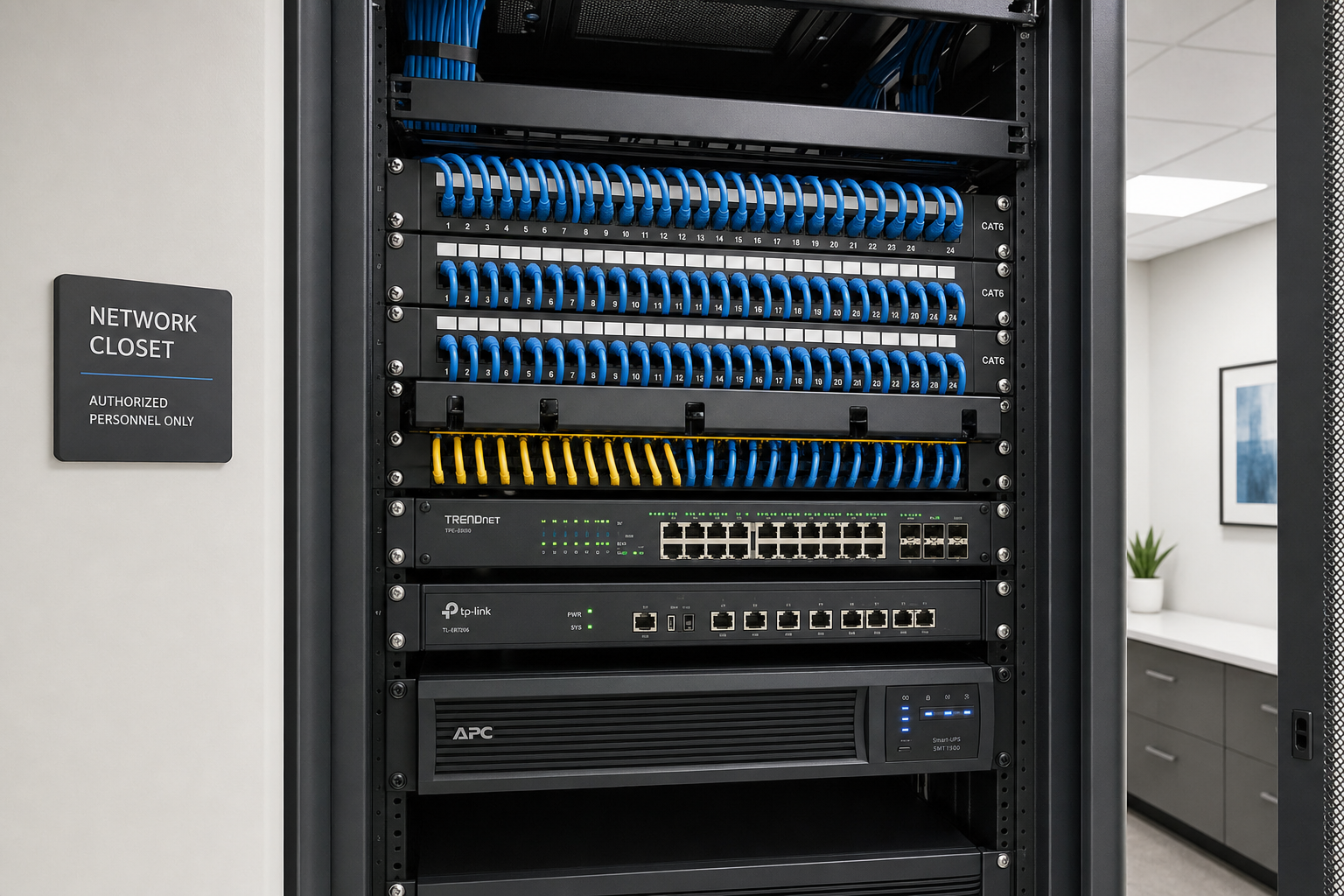
Messy network closets aren’t just an eyesore. Unlabeled cables, improper terminations, and undocumented runs create real operational risk — especially during an outage when every minute counts. Structured cabling done right, following BICSI standards, means clean installs, proper documentation, and a physical infrastructure that supports your technology for years without constant rework.
If your team has grown through multiple office expansions or moves, your cabling may be a patchwork of different installers and standards. That’s a problem worth fixing before it becomes an outage.
Common Objections Answered
“Managed IT costs more than what we pay now.”
On paper, a flat monthly fee looks higher than paying nothing until something breaks. But factor in one server failure, one ransomware incident, or one week of degraded productivity across 30 employees — and the math changes quickly. Managed IT replaces unpredictable emergency costs with a fixed, budgetable line item. Most businesses that make the switch find the total annual cost is comparable or lower, with significantly less downtime.
“We already have someone who handles IT.”
If that person is a full-time, qualified IT professional managing your environment proactively, that’s great. But if it’s an office manager who’s also handling IT on the side, or a part-time contractor who responds when called, that’s not the same thing. At 30-plus employees, IT needs dedicated attention — not a side responsibility.
“How long does setup take?”
Transitioning to managed IT with Mynians starts with a thorough assessment of your current environment. From there, onboarding is structured to minimize disruption. Most businesses are fully onboarded within a few weeks, depending on the complexity of their infrastructure. You won’t be left figuring it out on your own.
“What if we’re not in Winter Garden?”
Mynians serves businesses across Central Florida, including Orlando, Tampa, Miami, and Jacksonville. If you’re in the region and need local technicians who show up in person — not a remote helpdesk overseas — we can help.
How to Get Started
If your team has hit 30 employees and your IT support is still reactive, the first step is understanding exactly what you have and where the gaps are. That’s what a free IT assessment is for.
Mynians will review your current infrastructure, identify risks, and give you a clear picture of what managed IT would look like for your specific environment — no pressure, no vague proposals. Just real answers from local technicians with over two decades of hands-on experience in Central Florida.
Call us at (407) 374-2782 or reach out through our contact page to schedule your assessment.
Frequently Asked Questions
What is the difference between managed IT and break-fix support?
Break-fix IT support is reactive — you call a technician when something stops working and pay per incident. Managed IT is proactive — a provider monitors your systems continuously, handles patching and security, and resolves issues before they cause downtime, all for a flat monthly fee. At 30-plus employees, the proactive model is almost always more cost-effective and operationally reliable.
How much does managed IT cost for a 30-employee business?
Managed IT pricing varies based on the number of devices, the complexity of your infrastructure, and the services included. Mynians uses flat-rate pricing so there are no surprise bills. The best way to get an accurate number for your specific environment is to schedule a free IT assessment — we’ll give you a clear, honest proposal based on what you actually need.
Can Mynians handle our phone system and cabling too?
Yes. Mynians handles managed IT, hosted VoIP, and structured cabling under one roof. That means one team, one point of contact, and no vendor finger-pointing when something goes wrong. For businesses with 30-plus employees, having IT, phones, and cabling managed by the same local provider significantly reduces downtime and simplifies support.
What happens if we already have an IT person on staff?
Managed IT can complement an internal IT staff member rather than replace them. Many businesses use Mynians to handle monitoring, patching, and after-hours support while their internal person focuses on day-to-day user requests and strategic projects. We can structure the engagement around what your team actually needs.
Does Mynians serve businesses outside of Winter Garden?
Yes. Mynians serves businesses across Central Florida, including Orlando, Winter Garden, Tampa, Miami, and Jacksonville. We send real local technicians on-site when needed — not remote support from an overseas call center.
How long does it take to transition from break-fix to managed IT?
The transition timeline depends on the size and complexity of your environment. Mynians starts with a thorough assessment, then builds an onboarding plan designed to minimize disruption to your team. Most businesses complete the transition within a few weeks. You’ll have clear documentation and a stable, monitored environment by the time onboarding is complete.
Update Log
- May 2026: Created and reviewed for Mynians managed IT, hosted VoIP, and structured cabling accuracy. Content reflects current service offerings and Central Florida market conditions.